In 2021, I published a book called Innovate the Next. On its cover: an illustration of a flying Tesla Cybertruck, cruising over the surface of Mars.
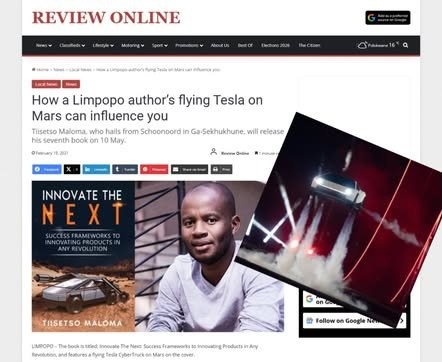
Last week, Elon Musk’s Tesla demonstrated a Tesla Roadster performing airborne stunts — driving upside down on a curved ramp and landing safely. It isn’t a flying car in any practical sense; it’s a demonstration vehicle built to show what’s technically possible.
Here’s what actually happened. At the October 2026 Tesla Roadster demonstration in Texas, the “Rocket” version used cold gas thrusters to perform a series of short, controlled stunts: it drove upside down on a curved ramp via a fan suction system, launched off the ramp, completed a mid-air roll, and landed. It also jumped over a row of Tesla vehicles — including a Cybertruck and a Semi — without a ramp, while performing a barrel roll. Tesla further claimed a 0–60 mph time of 0.81 seconds. The vehicle isn’t road-legal, access is invite-only, and production is claimed for 2028.
To be clear: I didn’t predict this. But I’d argue the book explains why it was possible.
The Tesla project is a partnership with SpaceX — motor engineers and rocket engineers working on the same vehicle. And every ingredient in that demonstration already existed: cold gas thrusters, fan suction, electric propulsion, the Roadster platform itself. What Tesla did was combine them. That’s the core argument of Innovate the Next: innovation isn’t conjuring something from nothing — it’s the combination of what already exists, assembled in adjacent, reachable steps.
The book traces this back to evolutionary biology and Stuart Kauffman’s Adjacent Possible theory, showing how novel products emerge by “stacking” existing pieces rather than appearing from nowhere. It then identifies the Enabling Factors for Product Success (behavioural utility, adjacent possible stacking, location advantages, convenience metrics, business model, luck) and the Human Greed Pyramid. Finally, it reverse-engineers these models into skills you can hone, and applies them to Fourth Industrial Revolution technologies to show how to see into the future as an innovator.
From the book, I also wrote the short Innovate Like Elon Musk.
Check them out if they’re of interest.